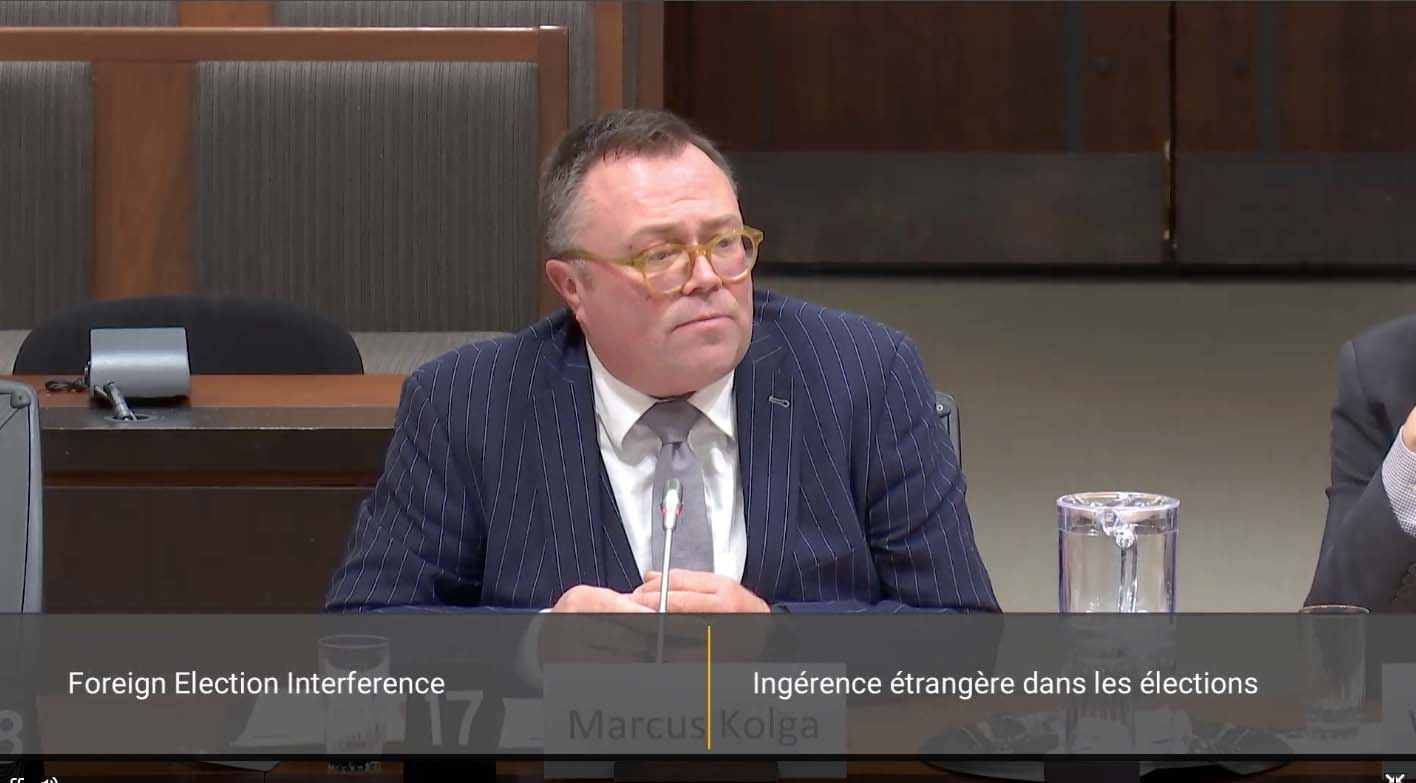
On December 2, 2025, Marcus testified in Parliament at the Standing Committee on House Procedures about foreign interference in Canada’s 2025 federal elections and the implementation of a foreign influence transparency registry.

His testimony below:
“Thank you, Chair, and members of the committee. It’s an honour to appear before you today.
For nearly 15 years, I have worked to document and expose foreign interference targeting Canada—whether orchestrated from the Kremlin, Beijing, Tehran, or Minsk. Since 2020, much of this work has been carried out through DisinfoWatch, the organization I founded to monitor and counter these threats. In parallel, I have spent just as long advocating for human rights defenders and pro-democracy activists—those struggling for freedom inside authoritarian states and those in exile who continue their work while facing harassment, intimidation, and transnational repression from the regimes they oppose. For that work, I am one of three Canadians named to both the Chinese and Russian sanctions lists – along with my colleagues and friends, Charles Burton and Sarah Teich.
The efforts of foreign authoritarian governments to undermine the integrity of our democracy, pollute our information space with falsehoods, erode social cohesion, and silence critics constitute a direct threat to Canada’s democratic and cognitive sovereignty.
Democratic sovereignty is our ability to govern ourselves without external coercion.
Cognitive sovereignty is our ability to form opinions and participate in our democracy based on facts—not narratives engineered abroad to distort our understanding of events.
Today, hostile authoritarian states are attacking both. They do not need tanks or missiles. Instead, they use covert influence networks, disinformation, intimidation of diaspora communities, and the deliberate exploitation of our openness. Their aim is clear: weaken trust, polarize society, manipulate our policy debates to serve their interests, and silence those who challenge them.
We have already seen these violations here at home. Threats from the Chinese government against activists who stand for office—such as Joe Tay—represent a direct assault on our democratic sovereignty. Members of Parliament Jenny Kwan and Kenny Chiu have also been targeted by coordinated disinformation campaigns designed to intimidate voters and punish critics of the Chinese Communist Party. Members of the the Uyghur Rights Advocacy Project and Canada Tibet Committee, have been sanctioned by Beijing—without any meaningful Canadian response.
Russia’s disinformation and foreign influence operations are equally aggressive and extensively documented. Ukrainian and Baltic communities in Canada have long been targeted by Kremlin narratives designed to dehumanize them—falsely branding them as fascists and “enemies of Canada” just as Russia has attempted to smear Ukraine’s democratically elected, Jewish president with the same slur. These narratives are a form of incitement to hate that has fuelled real-world harassment and vandalism, here in Canada.
Much of the danger comes from the use of local proxies—some knowingly, others drawn in by pressure, ideology, or profit. Moscow has relied on recruiting susceptible Canadians for nearly a century, a pattern revealed in the 1945 Gouzenko affair.
Without credible deterrence—meaning transparency, accountability, and consequences—our adversaries will continue to exploit our blind spots. That means holding accountable those who carry out these operations and, where appropriate, using sanctions laws to impose meaningful costs.
In June 2024, thanks in large part to the advocacy of vulnerable communities—including the Coalition for a Foreign Influence Transparency Registry, led by Gloria Fung—Parliament passed the Foreign Influence Transparency and Accountability Act.
Passing the Act was an important step toward transparency. But legislation alone does not defend us—implementation does. Repeated delays in operationalizing the registry risk sending conflicting signals about Canada’s commitment to confronting foreign interference, especially in the context of safeguarding future elections.
At the same time, it is essential that the public servants developing the regulations are given the time and resources to get them right: ensuring the registry’s purpose is clear, its infrastructure easy to navigate, and that it is enforceable in a consistent and meaningful way. We will not get a second chance on implementation. But delays beyond spring 2026 would seriously erode the trust of the communities most vulnerable to foreign intimidation and cast doubt on Canada’s determination to defend its democratic sovereignty.
Finally, the commissioner appointed to oversee the registry must have a deep and comprehensive understanding of the full spectrum of foreign influence threats—not only those posed by the Chinese Communist Party, but also Russia, Iran, and other authoritarian actors. Anything less risks creating blind spots that our adversaries will exploit.”