
Canada’s new foreign interference law is a good start. Will it work?
On August 11, The Globe and Mail published a new opinion piece by Marcus, Sarah Teich and Gloria Fung, “The new foreign interference law is a good start. Will it work?”
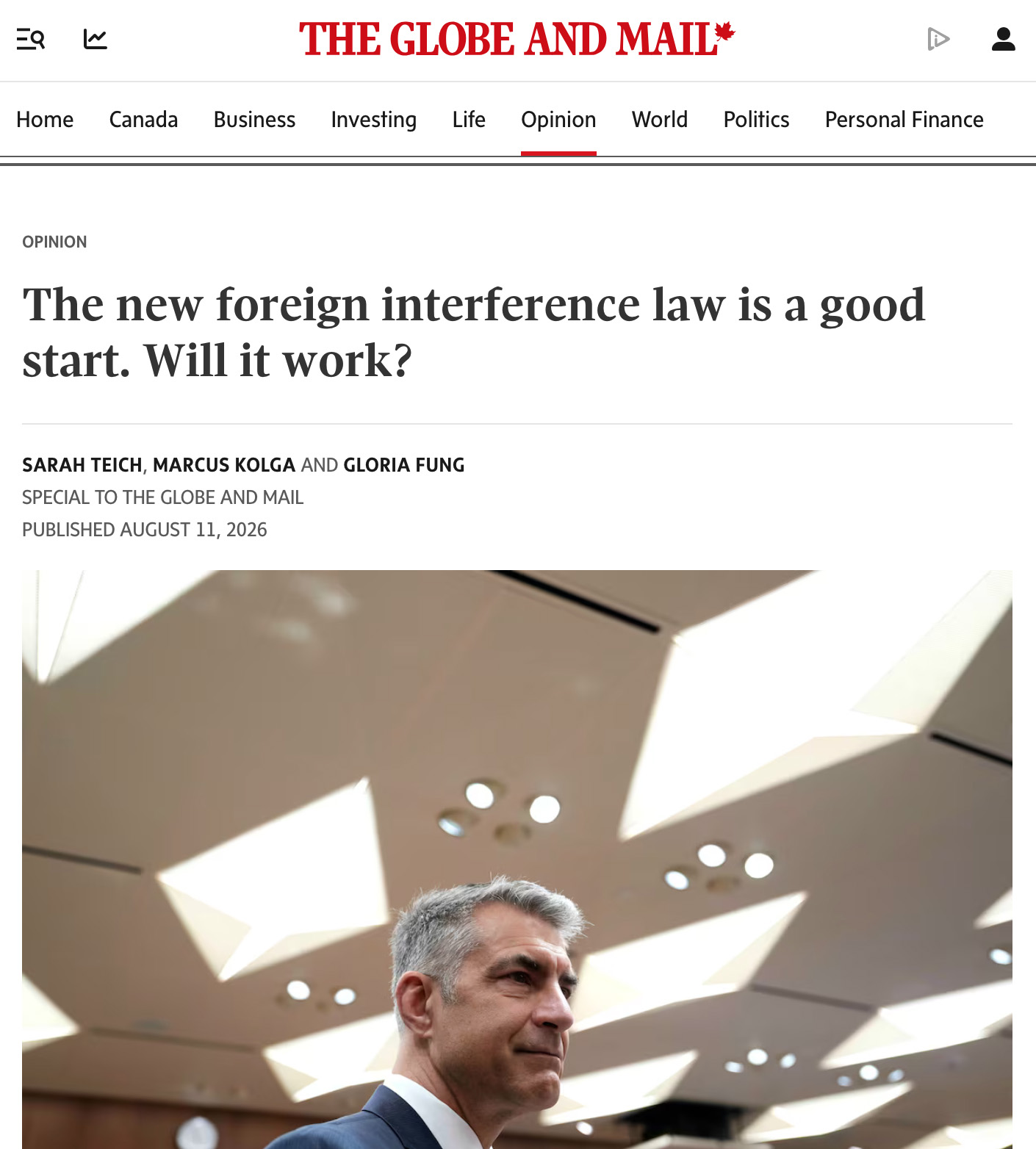
The article examines Canada’s new Foreign Influence Transparency and Accountability Act (FITAA), which came into force on August 4, along with the appointment of Anton Boegman as Canada’s first Foreign Influence Transparency Commissioner. Marcus and his co-authors argue that the legislation could become an important tool for countering foreign interference — but only if its implementation is strong enough to make the law meaningful.
Authoritarian regimes rarely interfere openly in democratic societies. Instead, they frequently operate through proxies, including community organizations, media outlets and ostensibly independent individuals. Requiring those acting under arrangements with foreign states to register publicly can help expose these relationships and provide greater transparency around efforts to influence Canadian politics and government.
The authors identify several areas that will determine whether the new system succeeds. Communities targeted by foreign interference need multilingual and secure ways to report it, particularly when victims fear retaliation against themselves or relatives abroad. Civil society organizations also need clear access to the Commissioner’s office and confidence that information they provide will result in meaningful action.
Transparency alone, however, is not enough. Marcus and his co-authors argue that effective referral mechanisms between the Commissioner, the RCMP, CSIS and the Canada Border Services Agency will be essential if evidence of foreign interference is to result in real accountability. Existing criminal and immigration laws already provide some tools, but they have rarely been used in this context.
The article also highlights a significant gap in Canada’s new framework: transnational repression. Canadians from Uyghur, Hong Kong, Tibetan, Russian, Ukrainian, Belarusian and other diaspora communities continue to face surveillance, harassment, disinformation and threats from authoritarian regimes. Unless those activities are directly connected to a political or governmental process, FITAA does not address them.
Canada’s new registry is an important step toward protecting the integrity of Canadian democratic institutions. But as Marcus and his co-authors conclude, protecting democratic processes is only part of the challenge.
The next step must be stronger protections for the Canadians who are themselves targeted by foreign authoritarian regimes.